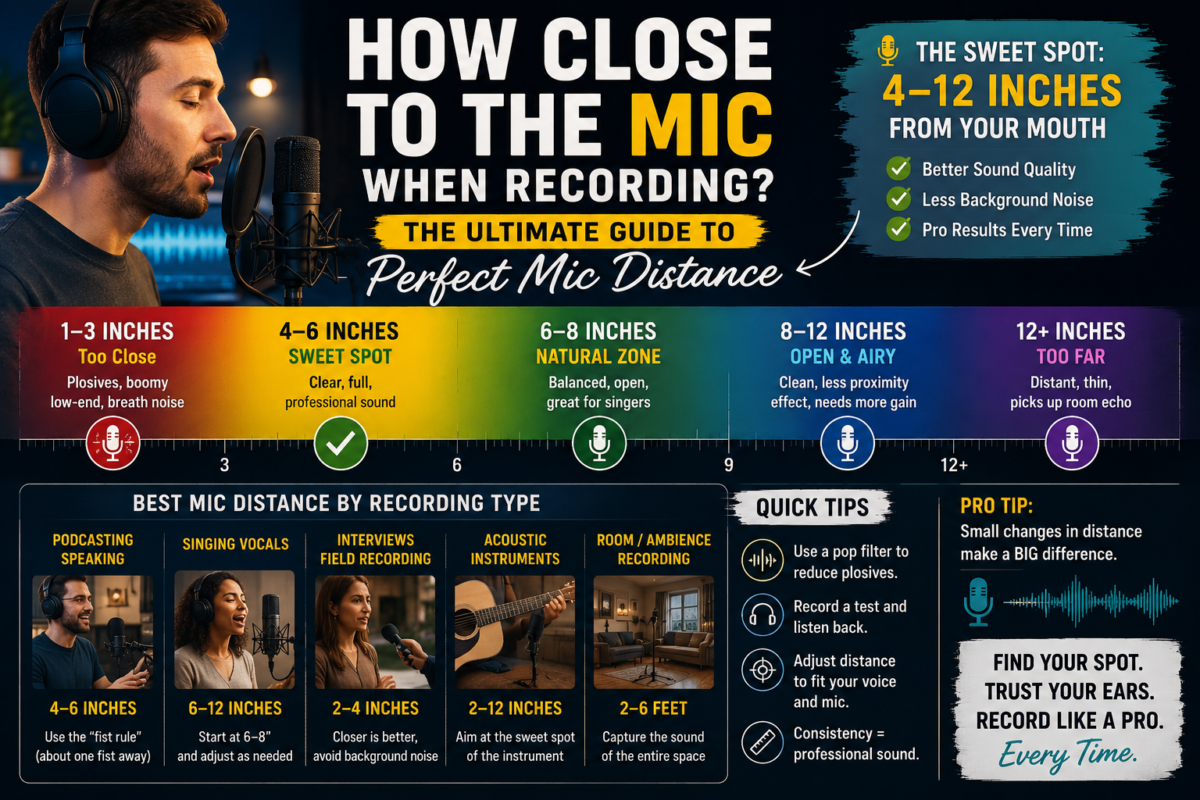
If you’ve ever recorded audio that sounded muddy, boomy, or too quiet, the problem might not be your microphone—it’s probably your distance from it. The secret to crystal-clear recordings is mastering how close to stand or position your mouth to the mic. For most speaking and vocal applications, the ideal microphone distance is between 4 to 12 inches from your mouth. This sweet spot captures your voice with clarity and presence while avoiding common audio issues like plosives (popping sounds from breath), excessive background noise, or a boomy tone.
Whether you’re recording podcasts, vocals for music, voiceovers, interviews, or YouTube videos, mic distance is one of the simplest things you can control to instantly upgrade your sound quality. You don’t need expensive gear or a professional studio—just the right placement technique. In this guide, we’ll break down exactly how close to be to the mic for different recording scenarios, why distance matters so much, and easy tricks to find your perfect spot every time.
Why Mic Distance Makes All the Difference
Your microphone doesn’t just hear your voice—it hears your voice + everything around it. The closer you are to the mic, the more of your voice it captures and the less of the room noise it picks up. This is called the “proximity effect.” When you’re close (around 4–6 inches), your voice sounds fuller, warmer, and more intimate. But if you’re too close (less than 3 inches), you’ll start hearing unwanted breath pops, plosives, and a overly boomy low-end that makes your recording sound unprofessional.
On the flip side, standing too far away (more than 12 inches) makes your voice sound thin, quiet, and distant. The mic also picks up more room echo, HVAC noise, keyboard clicks, and background chatter. Ever notice how professional podcasters sound so crisp and close while home recordings sound like they’re in an empty gym? That’s almost always about mic distance.
Here’s what happens at different distances:
The key takeaway? There’s no single “perfect” distance for everyone, but 4–8 inches is the golden range for 90% of recording situations. The rest is about tweaking based on your voice, your mic, and what you’re recording.
The Right Distance for Different Recording Types
Not all recordings need the same mic distance. Singers, podcasters, interviewers, and voiceover artists all have slightly different needs. Let’s break it down by scenario so you know exactly how close to be every time.
Podcasting and Speaking Applications
For podcasts, voiceovers, narration, and talking-head videos, the optimal microphone distance is 4 to 6 inches from your mouth. This distance gives you that “radio voice” sound—clear, confident, and intimate without sounding too close or boomy.
Many podcasters use the “fist rule”: hold your hand up in a fist and position the mic so it’s about one fist-length away from your mouth (roughly 4–6 inches). This is a super easy trick that works for almost anyone.
If you’re doing a podcast with multiple people sharing one mic, bump the distance out to 8–10 inches so everyone can be heard clearly without one person dominating the recording.
Singing Vocals (Pop, Rock, Rap, Country)
For singing vocals, the general rule of thumb is 6 to 12 inches away from the microphone. Why the wider range? Singers move more than speakers—they lean in for emotional parts, pull back for powerful notes, and sway with the rhythm. Starting at 6–8 inches gives you room to move without accidentally getting too close.
Different genres have different preferences:
- Pop and R&B: 6–8 inches for that smooth, intimate sound
- Rock and Metal: 8–10 inches to handle loud singing without distortion
- Rap: 4–6 inches (sometimes even closer) for that tight, aggressive sound, but use a pop filter to avoid plosives
- Country and Folk: 8–12 inches for a more natural, airy sound
If you’re new to recording vocals, grab a tape measure or ruler and actually measure 6 inches from your mouth to the mic. It sounds silly, but it helps you build the muscle memory for where to stand every time.
Interviews and Field Recording
When recording interviews (especially outdoor or on-the-go), the mic should be held about 3 inches from the person’s mouth for the clearest sound. This is closer than indoor recording because there’s usually more background noise outside.
Key tips for interviews:
- Never let your interviewee hold the mic—they’ll fidget and create noise
- Point the mic away from noisy backgrounds (traffic, crowds)
- Use a boom arm or handheld mic on a stand so it stays in the perfect spot
- Keep your hand planted on the mic stand and don’t move it during the recording
For video interviews where the mic needs to be hidden (like an on-camera mic), position it as close as possible without being in the frame—usually 6–10 inches works best.
Acoustic Instruments and Room Recording
Recording instruments is a whole different game. For acoustic guitar, start with the mic 6–12 inches away, pointed at the spot where the neck meets the body. For drums, overhead mics are usually 2–4 feet above, while snare mics are 1–2 inches above the rim.
If you’re recording a full band or room ambience, you’ll want to be much farther away—2–6 feet depending on the room size. The goal here is to capture the “space” of the room, not just the instrument.
Easy Tricks to Find Your Perfect Mic Distance Every Time
You don’t need a degree in audio engineering to nail mic distance. Here are four simple tricks that work for anyone:
1. The Fist Rule (Best for Podcasters)
Hold up your hand in a fist. The distance from your thumb to your knuckles is roughly 4–6 inches. Position the mic there. This is the most popular trick among podcasters because it’s fast, repeatable, and works for almost everyone.
2. The Two-Fist Rule (Best for Singers)
Stack two fists together. The distance from your thumb to the last knuckle is about 6–12 inches. This is perfect for singers who need room to move.
3. The Hand-Length Rule
Measure from the tip of your pinky to the tip of your thumb when your hand is open. That’s roughly 6–8 inches—perfect for most vocal recording.
4. The Tape Measure Method (Best for Beginners)
If you’re really new to recording, grab a tape measure or ruler and literally measure 6 inches from your mouth to the mic. Do this 3–5 times until you can feel where 6 inches is without measuring. Your brain will start to remember the spot.
Bonus Tip: Always Use a Pop Filter
If you’re recording within 4–6 inches of the mic (especially for rap or podcasting), use a pop filter between your mouth and the mic. This blocks plosives and breath noise while still giving you that warm, close sound.
Common Mic Distance Mistakes (And How to Fix Them)
Even experienced recordists make these mistakes. Here’s what to avoid:
Mistake 1: Standing Too Close
You’re less than 3 inches from the mic. Your recording sounds boomy, and you hear “popping” on words like “pop,” “potato,” and “baby.”
- Fix: Move back to 4–6 inches and add a pop filter.
Mistake 2: Standing Too Far
You’re more than 12 inches from the mic. Your voice sounds thin, quiet, and distant. You hear lots of room echo.
- Fix: Move closer to 6–8 inches. If your voice is still quiet, increase the gain on your recorder, not the distance.
Mistake 3: Moving Around Too Much
You lean in for emotional parts and pull back for loud parts, but your distance changes by 6+ inches. Your recording volume and tone fluctuate wildly.
- Fix: Find your sweet spot (6 inches is great) and stay there. If you need more dynamics, use your voice, not your body distance.
Mistake 4: Not Angling the Mic
You’re pointing the mic directly at your mouth. This maximizes plosives.
- Fix: Angle the mic slightly up or down (15–30 degrees) so breath goes past the mic instead of into it.
Mistake 5: Using the Wrong Mic for the Distance
You’re using a microphone that’s not designed for close recording (like some live sound mics) and trying to record 4 inches away.
- Fix: Most cardioid condenser mics love 5–6 inches+ with a pop filter. Check your mic’s specs before recording.
Final Tips for Recording Like a Pro
Here are a few last tricks to take your recordings from “home studio” to “professional”:
- Test before you record: Say a few sentences and listen back. If it sounds boomy, move back 1 inch. If it sounds thin, move closer 1 inch. Repeat until it’s perfect.
- Use a boom arm: A boom arm keeps the mic steady at the exact distance you set. No more accidentally moving it 3 inches closer while you’re singing.
- Record in a quiet room: Even at the perfect distance, a noisy room will ruin your recording. Turn off fans, close windows, and record when it’s quiet.
- Don’t fidget: Plant your hand on the mic stand and don’t move it during recording. Every movement changes your distance and ruins consistency.
- Experiment: Your voice is unique. Someone else’s perfect 6 inches might be 7 inches for you. Try 4, 5, 6, 7, and 8 inches and pick the one that sounds best to YOU.
Your New Go-To Mic Distance
So, how close to the mic when recording? The answer is simple: 4 to 8 inches is your golden zone for most speaking and vocal recordings. Start at 6 inches, test it, and tweak by 1-inch increments until your voice sounds crystal clear, warm, and professional.
Remember:
- Podcasts and speech: 4–6 inches
- Singing vocals: 6–12 inches
- Interviews: 3 inches (outdoor) to 6 inches (indoor)
- Always use a pop filter if you’re under 6 inches
Mic distance is the easiest free upgrade you can give your audio. No expensive gear, no fancy plugins—just move your mic (or your mouth) a few inches and instantly sound better. Now grab your mic, measure 6 inches, and record something that sounds amazing. You’ve got this!